Thursday, July 13, 2006

A New EZine!

Announcing Serve! a new ezine.

The publisher, Steve Sjogren - who is the founding pastor of Vineyard Community Church in Cincinnati, Oh - writes:

"The writers of each of these issues come from a variety of backgrounds. Some will be well-known. Others will be people you’ve never heard of, but they will all have one thing in common: They are doers, not theorists, of outwardness. They are all ones who live, day after day, a lifestyle of walking out the generosity, kindness and practical love of Christ that changes the world around us. Therefore the stories they share are practical… and they work! " (emphasis mine)

The editor is Charlie Wear, who himself is the publisher of the well-known emerging church organ, Next-Wave. The production values are also good with the zine being done by Malcolm Hawker of webDesign Studio in Australia. Hawker also has done work for The Ooze, Allelon, and DTour.

A online publication that focuses on practical spiritual issues is to be applauded!

Check it out!

a great quote


Some/most of you know I work for USA TODAY. I rarely mention it here, but today I was in a meeting with some of our VPs and my VP made a quotable remark:

"Don't provide advice when what is needed is time."

I thought it was worth repeating.

Reminds me of one of my favorite Stephen Covey quotes (that has served me well in my marriage): "Don't try to talk yourself out of something you've behaved yourself into."

Part of an addiction to propositionalism can manifest itself as striving to resolve every problem with words. Some situations are best addressed by time, effort, and love.

freelance writing: how much should I charge??

This article, from Writers Market, was enormously helpful to me recently in determining a fair rate for a new writing project.

on ji packer

Justin Taylor was given the happy task of hosting JI Packer at the International Christian Retail Show (sponsored by the Christian Booksellers Association) that's going on right now in Denver. He's been posting some of his observations after spending time with the renown author.

- first post
- second post (how to be a better writer)
- third post

Worth reading.

The Implosion of Liberal Christianity

a helpful caution on becoming laissez-faire about doctrine:

"When a church doesn't take itself seriously, neither do its members. It is hard to believe that as recently as 1960, members of mainline churches — Episcopalians, Presbyterians, Methodists, Lutherans and the like — accounted for 40% of all American Protestants. Today, it's more like 12% (17 million out of 135 million). Some of the precipitous decline is due to lower birthrates among the generally blue-state mainliners, but it also is clear that millions of mainline adherents (and especially their children) have simply walked out of the pews never to return. According to the Hartford Institute for Religious Research, in 1965, there were 3.4 million Episcopalians; now, there are 2.3 million. The number of Presbyterians fell from 4.3 million in 1965 to 2.5 million today. Compare that with 16 million members reported by the Southern Baptists.

When your religion says "whatever" on doctrinal matters, regards Jesus as just another wise teacher, refuses on principle to evangelize and lets you do pretty much what you want, it's a short step to deciding that one of the things you don't want to do is get up on Sunday morning and go to church."

- the entire LA Times opinion piece

update: i'm not endorsing every single word of the article and would have phrased some things differently, but I affirm her larger point that we need to take care to pay attention to doctrine.

ht: andrew jackson

Wednesday, July 12, 2006

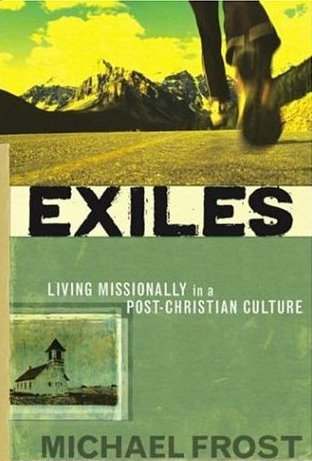
new book by mike frost

from the publisher:

"Exiles: Living Missionally in a Post-Christian Culture presents a biblical, Christian worldview for the emergent church—people who are not at home in the traditional church or in the secular world. As exiles of both, they must create their own worldview that integrates their Christian beliefs with the contemporary world. Exiles seeks to integrate all aspects of life and decision-making and to develop the characteristics of a Christian life lived intentionally within emerging (postmodern) culture. It presents a plea for a dynamic, life-affirming, robust Christian faith that can be lived successfully in the post-Christian world of twenty-first century Western society. This book will present a Christian lifestyle that can be lived in non-religious categories and be attractive to not-yet Christians.

Such a worldview takes ecology and politics seriously. It offers a positive response to the workplace, the arts, feminism, mystery and worship. Exiles seeks to develop a framework that will allow Christians to live boldly and courageously in a world that no longer values the culture of the church, but does greatly value many of the things the Bible speaks positively about. This book suggests that there us more to being a Christian than meets the eye. It explores the secret, unseen nooks and crannies in the life of a Christian and suggests that faith is about more than church attendance and belief in God. Written in a conversational, easy-to-read style, Exiles is aimed at church leaders, pastors and laypersons and seeks to address complex issues in a simple manner. It includes helpful photographs and diagrams."


this will be a must buy.

Tuesday, July 11, 2006

Breaking News: One of the Founders of Pink Floyd Dies

"Syd Barrett, the troubled talent who co-founded Pink Floyd but spent his last years in reclusive anonymity, has died, a spokeswoman for the band said Tuesday. He was 60."

-the Associated Press story

Andreas Kostenberger on The Gospel of Judas

"We conclude, therefore, that the Gospel of Judas is not truly a Gospel; it does not go back to the “historical Judas” and does not preserve reliable tradition about Jesus or the Betrayer; and, while probably authentic, it contributes to a better understanding of Gnosticism but not of the biblical gospel or the true meaning of the sacrifice of Christ."

NT Scholar Andreas Kostenberger blogs on the Gospel of Judas.

Monday, July 10, 2006

are there emerging church shibboleths - revised

next-wave picked up my earlier post on the topic. I've also made some revisions.

Sen. Barack Obama on Faith in the Public Square

"...it's wrong to ask believers to leave their religion at the door before entering the public square. Abraham Lincoln, William Jennings Bryan, Martin Luther King Jr. — indeed, the majority of great reformers in American history — were not only motivated by faith, they also used religious language to argue for their cause. To say men and women should not inject their "personal morality" into policy debates is a practical absurdity; our law is by definition a codification of morality."

Barack Obama, US Senator from Illinois (Dem) in a USA TODAY editorial today.

Sunday, July 09, 2006

Saturday, July 08, 2006

Mark Driscoll on the Reformed Emerging Church

"Traditional churches have either leaned toward being fundamentalist and separated from culture, which has led to legalism and irrelevance; or they have leaned toward being liberally synchronized with culture, which leads to compromise and irrelevance. Either way, many traditional churches are irrelevant, whether they lean to the Left or the Right theologically and politically. Most contemporary churches are not very theological beyond a few evangelical basics, because they are guided more by pragmatism and programming than theology. At Mars Hill Church, we are driven by Reformed theological convictions and emerging missional methods. I like to say we are theologically conservative and culturally liberal."

- the full CT interview.

5 Quick Tips to a Better Blog

- worth reading (pdf)

ht: jordon

Friday, July 07, 2006

TR Revisited


I posted the post below 3 years ago. I repost it today after discovering to my delight that Time Magazine has devoted their 3 July issue to Teddy. Beth had picked up a copy for me and it provides a good primer to his life with several articles. Great stuff and I love this guy. You can get a taste below.

---------------

The Rise of Theodore Roosevelt

I just finished reading Edmund Morris' wonderful The Rise of Theodore Roosevelt, which was originally published in 1979 and won a Pulitzer. It hit my radar screen when some weeks ago I decided to join the History Book Club and choose Morris' Theodore Rex as one of my selections. After I began reading and enjoying it, I discovered that it was the second in a projected three volume series that Morris began on TR two decades ago. So I set Rex down and purchased vol 1 and drank it in. It's wonderful and now I'm a bona fide TR fan. This man was incredible. Here's a quote from Theodore Rex that quickly summarizes TR's life in terms of accomplisments:

"He had been a published author at eighteen, a husband at twenty-two, an acclaimed historian and New York State Assemblyman at twenty-three, a father and a widower at twenty-five [TR lost his first wife and mom on the same day just after his first daughter Alice was born], a ranchman at twenty-six, a candidate for Mayor of New York at twenty-seven, a husband again at twenty-eight, a Civil Service Commissioner of the United States at thirty [appointed by the President]. ...Police Commissioner of New York City at thirty-six, Assistant Secretary of the Navy at thirty-eight, Colonel of the First US Volunteer Calvary, the "Rough Riders," at thirty-nine."

TR went on to become Governor of New York at age forty, then Vice-President and then an assasin's bullet made him the youngest President ever at age forty-two (Kennedy was the youngest person *elected* President at forty-three; Clinton was forty-five when we became president).

TR spoke German and French, attended Harvard. He was an amateur boxer, a policeman, started a finance club, a stockmen's association and an extremely influential hunting-conservation society (connected with the start of both the National Zoo and of Yellowstone National Park). He climbed the Matterhorn and "became a world authority on North American mammals."

TR wrote 38 books, including his first book, The Naval War of 1812, which he published when he was 23 years old. It was instantly considered by both England and America as the definitive work on the subject and within five or six years the US govt established a requirement that every US Navy ship have at least one copy on board. Morris adds,

"Eleven years later, when Great Britain was preparing her own official history of the Royal Navy, the editors paid Theodore the unprecedented compliment of asking him to write the section of that work dealing with the War of 1812" (p. 136).

I loved this book and found much to admire in TR.

Two things stood out to me: 1) his activism. TR was a doer. He made things happen. 2) his joie d'vivre. One contemporary said, "The important thing to remember about TR is that he's about six years old." His favorite exclamation was "Deeeelighted." He was a commendably optimistic individual.

I recommend this book and his life as worthy of study. I'm now rejoining Theodore Rex and dreading finishing it already.

------------------------

I went on to finish Theodore Rex and found that Teddy's pre-presidential life was more interesting than his days in the White House. I've also found this to be true with other Presidents, especially Lyndon Johnson as portrayed by Robert Caro in the most magnificent set of biographical work I've ever read.

Thursday, July 06, 2006

just a prayer request

One story of so many from Louisiana.

What is the Emerging Church?

A pretty good around-the-room list of resources for those who wish to begin to wrap their brain around the emerging church.

Wednesday, July 05, 2006

New African Bible Commentary


Steve Knight, who has taken on a new role as SIM's International Communication Coordinator, reports:

"I’m writing to let you know about an exciting project that SIM has been involved with called the “Africa Bible Commentary”! It’s the first-ever complete commentary of the entire Bible written in Africa by African theologians for African pastors and practitioners. Of course, Zondervan is publishing and distributing it in the U.S., and Rick Warren and John Stott (among others) have given it rousing endorsements – so we’re hopeful it will gain an even broader, international audience.

The launch event for the “Africa Bible Commentary” is today in Nairobi, Kenya, and our SIM International Director, Malcolm McGregor (he’s Scottish), is there to speak, along with former President of Kenya Daniel Arap Moi, who is giving the keynote address. This is BIG news for the African church! "

Learn more here!

The New Discerning Reader Online Bookstore

the discerningreader.com domain, formerly owned by rob schlapfer, has been purchased by tim challies. he's now running a new bookstore at that address.

ht: andrew jones

Tuesday, July 04, 2006

the brotherhood of man

"Whoever it was probably lived a few thousand years ago, somewhere in East Asia — Taiwan, Malaysia and Siberia all are likely locations. He — or she — did nothing more remarkable than be born, live, have children and die.

Yet this was the ancestor of every person now living on Earth — the last person in history whose family tree branches out to touch all 6.5 billion people on the planet today."

a fascinating AP article on geneology and mathematics

Sunday, July 02, 2006

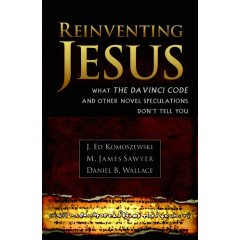
Book Recommendation: Reinventing Jesus


I just started reading Reinventing Jesus by Daniel B. Wallace, M James Sawyer, and J. Ed Komoszewski. It's an excellent and unique treatment that deals with three critical issues surrounding the development of early Christianity:

  • The development of the New Testament canon. One of the unique features of the text is that while some wonder why the early followers of Jesus didn't pen gospels earlier, the authors discuss the early church emphasis on proclamation and the importance of oral tradition.

  • The view of the Ante-Nicene and early church of Jesus' divinity.

  • The question of primary Christian concepts deriving from other ancient religions.
Though the book is being marketed in response to the Da Vinci Code, its purview extends beyond Brown's speculations to several other key Search for the Historical Jesus/Early Christian Development discussion threads.

I'll post a fuller treatment when I complete the book but I've read enough to say that this one is highly recommended.

Darrell Bock, who has written one of the best Da Vinci Code treatments - Breaking the Da Vinci Code, also recently recommended the book.

For more information on the book, see the Reinventing Jesus Website.

Saturday, July 01, 2006

getting post-definitional

scot mcknight discusses categorizing resonance streams within the emerging church and helpfully points us all to a post-definitional praxis stage!

though - as I indicated earlier - i find categorizations helpful for the purpose of description and mutual understanding, i appreciated scot's comment because it's not too difficult to imagine spending too much time discussing definitions and not enough time giving bread to the hungry and telling them about our Savior.

Thursday, June 29, 2006

are there emerging church shibboleths?


Mark Driscoll of Mars Hill Church in Seattle has become something of a flashpoint in the emerging church conversation because he's been so adamant about not being an emerging church revisionist (using Ed Stetzer's term for emergers who wish to modify, or at least discuss modifying, long-held theological beliefs such as substitutionary atonement and the nature of hell). The claim of some that Driscoll isn't "emerging" based on some of his traditionalist theological beliefs has led to a discusson on the faithmaps discussion group as to whether or not there are emerging church shibboleths.

In contrast, emergent's National Coordinator, Tony Jones, in a piece critical of Stetzer's taxonomy and Driscoll's differentiation of "evangelical emergers" from "liberal emergents", has written passionately that emergent welcomes their inerrantists, complimentarians as well as their "Bush-loving neocons."

One thing that the various categorization schemes out there (and I offered one myself a while back) do reveal is that folks have different resonances with the emerging church conversation (here's mine). Some really are just trying to communicate better to postmoderns. Others want to do that and they also want to radically change how church is done. And others really do believe the time has come to tweak the church's theology.

With due respect to Stetzer (for I do find his categories helpful), I think that one of the things that hindered his nomenclature from being more favorably viewed was when he seemed to lump all of the revisionists together and basically dismisses all of their theological speculations with the comment that "their prescriptions fail to take into account the full teaching of the Word of God." Then he writes, "Revisionists are questioning (and in some cases denying) issues like the nature of the substitutionary atonement, the reality of hell, the complementarian nature of gender, and the nature of the Gospel itself" as if these matters were of equal importance. He seems to reject any degree of revisionism out of hand.

However, even so Reformed and conservative a leading light as the great exegete John Murray once commented,

"However epochal have been the advances made at certain periods and however great the contributions of particular men we may not suppose that theological construction ever reaches definitive finality. There is the danger of a stagnant traditionalism and we must be alert to this danger, on the one hand, as to that of discarding our historical moorings, on the other."

Murray continues, "When any generation is content to rely upon its theological heritage and refuses to explore for itself the riches of divine revelation, then declension is already under way and heterodoxy will be the lot of the succeeding generation.... A theology that does not build on the past ignores our debt to history and naively overlooks the fact that the present is conditioned by history. A theology that relies on the past evades the demands of the present"(emphasis mine, from his article "Systematic Theology" - see Looking Beyond the Facade of Modernity, Part 2).

Those critiques of Stetzer's comments aside , I'll nevertheless suggest that categorization can be helpful as a discussion tool as long as we don't collapse folks down to their category. They help us to see the different ways in which we are interested in the emerging church conversation.

And perhaps the one legitimate shibboleth for emergers is a dissatisfaction with the status quo.

photo courtesy of kindhelper @ stock.xchng

Wednesday, June 28, 2006

mark driscoll on streams within the emerging church

mark driscoll of mars hill differentiates the emerging church and emergent in this brief video interview clip. Echoing the taxonomy first laid out by ed stetzer, driscoll extends stetzer's categories of relevants, reconstructionists, revisionists by adding a fourth category which he characterizes as "reformed/missional."

i'm not sure driscoll means to deny the missional description to the other ec streams. and i'm not sure it's helpful to denominationalize (and I realize "reformed" is trans-denominational, but you get my point) the emerging church conversation.

nevertheless, the reformed participation in the emerging church is notable and we had commented on that some time ago.

ht: justin taylor

Tuesday, June 27, 2006

"Goodbye to the White House Evangelical"

Get Religion has a nice piece on Michael Gerson's exit from the Bush Administration.

Monday, June 26, 2006

transpropositional evangelicals

Beth and I have been involved in our church's KatrinaGrace ministry, which so far has sent 7 teams to either Louisiana or Mississippi to work on Katrina relief. As one who has criticized the evangelical church as being overly propositional, I've been very encourged by the fact that I'm only aware of one or two evangelical churches that aren't sending folks to work in the area.

Recently, Stephen Monsema completed a four year study of 500 welfare-to-work programs in LA, Chicago, Dallas and Philly. One of his most interesting findings - and one that contradicted conventional wisdom - was that most of the Christian programs were evangelical and not mainline. Christianity Today Senior Associate Editor Agnieszka Tennant interviewed Monsema on his findings about transpo evangelicals.

Sunday, June 25, 2006

more mike frost

a friend of mine found the rest of the series that jordon has been posting.

great stuff!

from the site:

"Michael Frost is the Director of the Centre of Evangelism and Global Mission (CEGM) at Morling College, Sydney. He has shared the gospel extensively throughout Australia and overseas and is a highly sought after speaker.

Michael has written a number of books including The Shaping of things to Come(co-authored with Alan Hirsch), Jesus The Fool, Longing For Love, Seeing God in the Ordinary and Eyes Wide Open (Christian Book of the Year in 1999).

He is often invited to speak at conferences and conduct seminars on Christian belief. Michael has a gritty, pragmatic and challenging style that engages us with the power, passion and wonder of God's love in Jesus Christ. "

Friday, June 16, 2006

gone fishin'

emergesque goes dark while we go to the beach for a week!

Very Helpful New Bible Reference: The HyperConcordance

"Each hyperlinked word takes you to a new list of verses for that word, so you can go directly from one set of word contexts to another. All words are grouped according to their dictionary forms, ignoring plurals and inflected verb forms. So in this example, the word "said" is linked to its dictionary form "say". Likewise, the noun "measure" and the verb "measured" both link to the same entry. If you hover over a link, a tooltip displays how many entries there are for that word. "

- The New Testament Hyper-Concordance

ht: Andrew Jackson

Thursday, June 15, 2006

more mike frost talks

@ remix.

mike co-wrote The Shaping of Things to Come with Alan Hirsch.

I haven't heard a talk of his I haven't loved. Great stuff.

Wednesday, June 14, 2006

The Southern Baptist's New President on the Emerging Church

"I see many valuable contributions to the SBC coming from the Emergent Leaders Movement. I believe it is a positive thing to see a broader number of participants in our convention’s direction. I personally applaud this movement."

from an interview of Dr Frank Page, who was elected this week as the SBC's new president.

Now that's not a quote you see every day coming from a Southern Baptist President!

Time Magazine says that bloggers elected this president (and then admits it's a bit more complicated).

Also, see the NY Times article on the election (free registration required),

ht: Andrew Jones

Best Books on the Emerging Church


according to Andrew Jones, a-list ec blogger.

Tuesday, June 13, 2006

more mclaren on criticism

In a recent Darren King interview, Brian McLaren speaks about ec criticism.

He also addressed this in a later piece he wrote for emergent village.

Saturday, June 10, 2006

a great flickr hack

One of the unfortunate limitations of flickr, even with a paid acct, is that slideshows don't show captions. (Other than this, I love flickr and will reup when my $35 yearly sub expires).

Some guy at Harvard has put together a marvelous hack that adds this feature. Click here.

We used this for our slideshows from our Katrina Relief trip last week (pics from the Lower 9th Ward in New Orleans, Slidell, Covington and vicinity).

great advice for new (or not so new) writers

from 52 Projects.

Lots of advice and links. Very helpful.

ht: jordon

Friday, June 09, 2006

Cars

Beth, Michaela, Skye, Alia and I saw Cars tonight and it was fantastic. Unbelievably vivid animation - very rich and I need to see it again to catch it all - and the story might be the most wholesome and helpful one I've seen in forever. Highly, highly recommended. The critics are liking it too.

The Orange County Weekly on Jim Gilliam

OCW ran a nice piece on Jim, who is awaiting a double-lung transplant while fighting for what he believes in. I met Jim through Will Samson when Will and I and others were participating in the Internet Evangelism in the 21st Century Conference. Jim was there working on a documentary.

While Jim and I don't agree on everything , I admire his passion, commitment and sheer intelligence. And he is a gentleman.

Please pray that Jim would get lungs very soon. He's down to 17% capacity.

Thursday, June 08, 2006

Brian McLaren on Controversy

Brian posts a three part message on controversy surrounding the emerging church and emergent.

Wednesday, June 07, 2006

theopedia...

is a growing online encyclopedia of Christianity and Biblical Theology.

from the site

ht: Brad Boydston

Tuesday, June 06, 2006

Monday, June 05, 2006

i'm back

A report and pics of our Katrina relief trip to the New Orleans area can be found here.

Saturday, May 27, 2006

gone to new orleans

emergesque goes dark until Tuesday 6 June while I'm working in New Orleans.

faithmaps.org has relaunched

Thanks to Scot McKnight over at Jesus Creed for mentioning our relaunch. Just a point of clarification though; it's faithmaps.org that's relaunched, not emergesque.

(I put a note in comments on Scot's site).

Friday, May 26, 2006

Karla Yaconelli on Zondervan's Acquisition of Youth Specialties


"It's been a big week. For some of you, the news of Zondervan's acquisition of YS came as no giant surprise, rather as a straightforward and natural transition. For others, it came as quite a shock, accompanied by varying degrees of skepticism and disappointment.

Both reactions (and all the ones in-between) are valid.

..."


Karla posts her thoughts.

Thursday, May 25, 2006

Best Books on the Da Vinci Code

Roger N Overton over at the A-Team Blog provides an impressive around-the-room of books that have been written about the Da Vinci Code. He reviews and rates each one.

- Suggested Resources on The Da Vinci Code

Wednesday, May 24, 2006

Darrell Bock's Review of the Da Vinci Code

"The film offers an awkward, secular attempt to grasp for a type of faith without divinity, whose message is, essentially: All that matters is to believe something, even if that something has nothing to do with truth and lacks any real substance. Ads for the movie challenge us to "seek the truth," but in the end, there is little truth worth seeking in the story's groping for a coherent spiritual message. An average movie, "The Da Vinci Code" offers nothing more than spirituality lite. "

- full review

- Suggested Resources for the Da Vinci Code

Saturday, May 20, 2006

for missio dei

When I was an undergraduate, I decided to become a professor of New Testament or Greek in either a Christian college or seminary. I wanted to be a part of training the church’s future leaders. This decision seemed to require that I go to where I could find the necessary books and the folks who had read and studied them. And so I transferred to another college where I could complete a bachelors degree in Classical Greek and Bible. I then entered Seminary to continue my work of preparation.

But then midway through my Masters’ work, I almost quit school when I came to the conclusion that seminaries (at least my seminary), while doing a fine job at preparing biblical scholars, weren't preparing spiritual leaders. I found that the statement of one of my professors was true: "We don't train you how to be pastors. We train you how to answer Bible questions."

But rather than dropping out, I decided to finish what I had begun and came to write my thesis on how the first century church trained her leaders. I wrote that the seminaries expect the churches to send them people ready for spiritual leadership and the churches expect the seminaries to send them people ready for spiritual leadership and that as a result no one was doing the work of preparing spiritual leaders. I fear this is still too true today. Traveling to a distant place at great expense to focus on information – even biblical information – for an extended length of time might not be the best way to become a leader.

In their wonderful investment book,
FutureWealth, Francis McInerney and Sean White argue that society changes as the cost of information declines.

The Protestant Reformation could be cited as an example of just such a societal change .
Johannes Gutenberg invented the printing press in 1440. As a result it was less expensive to provide people with information about God and Christianity and folks were less reliant upon the religious hierarchy of the Roman Catholic church. Society changed in the 16th century when religious leaders broke away from that existing leadership structure.

With the advent of radio, before the United States entry into World War II, FDR was able to appeal directly to the American public to convince it to lend Great Britain equipment (
Lend-Lease). The now ubiquitous television further lessened the cost of information and has transformed society in myriad ways.

Author Rex Miller (The Millennium Matrix) calls the time of radio and television the period of Broadcast and says that we now are in the Digital or Interactive Age.

The Internet brought two innovations to mass communication. It dramatically lowered the cost of platform – today in the West almost anyone can reach millions through blogs or websites. And the new online medium also enabled information purveyors to
interact easily with their audience. Furthermore, information collectors and transmitters can interact as peers, synergizing with one another for superior results (this also has profound implications for how the church can now do theology).

Accordingly, it's less necessary than ever to go to where the books and those who have read them are. But that is still the default approach in the developed world for training Christian pastors. This is not too surprising. In technological development, first comes hardware, then software, and then - lagging way behind - is people finally executing the most efficient application of new technology. Consider the high casualties as a result of the American Civil War combatants using archaic 18th century battle strategy with 19th century technology. They just lined up against each other and mowed each other down with better weapons.

But our challenge today is not just that we aren’t fully optimizing current technology as we train leaders. We also are relying overmuch on information as the omnicompetent mode of spiritual transformation. (We see leadership development and spiritual transformation as significantly overlapping). We see a more holistic approach practiced by Jesus and advocated by his first followers.


Some consider that modernism has played a role in this overemphasis.
Descartes - considered by some as the father of modernism - in his Discourse on Method, wrote, "all things…are mutually connected in the same way, and that there is nothing so far removed from us as to be beyond our reach, or so hidden that we cannot discover it…." Perhaps such an implicit assertion of the vast ability of the human mind laid the seed for the church’s unwarranted confidence in information as the primary path for spiritual change. Perhaps this jump in logic occurred because information acquisition is so easily measured. The certain measurement of the degree to which someone has mastered a specific body of knowledge might be over-interpreted as indicating a mastery of that which transcends mere knowledge. And yet, as neither the brain surgeon nor the air traffic controller can master their tasks through reading books, so also the successful pastoring of Christians requires far more than information acquisition. Something else is necessary. This deficiency in our approach to the formation of spiritual leaders is far more significant than our not taking full advantage of the latest technology.

Jesus definitely transferred information to his disciples; we are not advocating that biblical knowledge is anything less than absolutely necessary. But Jesus also spent time with his disciples, lived with them, ate with them, served with them, and interacted with them. After Peter and John were arrested and brought before the Jewish leaders, Peter proclaimed salvation in Jesus Christ to them. Luke records that the rulers, scribes and elders “observed the confidence of Peter and John and understood that they were uneducated and untrained men, they were amazed, and began to recognize them as having been with Jesus” (Acts 4:13, NASB, emphasis mine). Mark notes that earlier Jesus “appointed twelve—designating them apostles —that they might be with him and that he might send them out to preach” (Mark 3:14, NIV, emphasis mine). Being with Jesus – and not just hearing what he had to teach – was a critical component of his followers’ development. Paul reflects this same emphasis when he advises his protégé, Timothy, that he should “continue in the things you have learned and become convinced of, knowing from whom you have learned them (emphasis mine, 2 Timothy 3:14, NASB). The impartation of information in the New Testament – admittedly a critical component of spiritual formation – is not divorced from the relationship which is its context. While the declining cost of information might make it easier for us to over-depend on it for spiritual change, it is the local face-to-face connection that is the typical context for spiritual growth. When folks list what’s been most spiritually transformative in their lives, they usually list names, not books, classes, lectures or even sermons. And when this relational context of spiritual development is recognized, it is then that the declining cost of information can truly be appreciated and utilized. For the cheap availability of biblical information now makes spiritual formation geographically agnostic; one can get the information one needs locally and stay in local community and local relationships. A promising leader need not be ripped out of their local context to grow in the womb of some far away high tower. They can grow where they are planted to give back to those from whom they’ve received.

faithmaps.org was originally created five years ago to supplement a class that I was teaching at
Cedar Ridge Community Church while on staff there. Later I purchased the domain from CRCC and developed it further. faithmaps.org is now being relaunched under a new design and structure to aid mentors and protégés and anyone who is looking for a portal to excellent websites and articles (and some original material) that cover theology, praxis, leadership, and other topics of interest to the church in postmodernity.

There are two online contexts of interaction around the faithmaps material: the emergesque blog and the long-running faithmaps discussion group. And while genuine spiritual connection does happen in these and other online contexts, faithmaps.org is primarily intended to supplement life-on-life spiritual discipleship in real time. Such online resources then become not the silver bullet of growing into Christ, but one valuable set of resources in a multifaceted, very interpersonal, and very local process.

We do not mean to sound the death knell for the theological seminary. First of all, we need such graduate schools as the academic study of the Scriptures, theology, the church, etc. is also necessary. And, secondly, a more holistic, balanced, and relational model could perhaps be developed in a seminary context (and maybe it’s already out there).

However, in days to come, we genuinely hope that a new praxis and model of leadership development will arise that is more holistic, local, relational, and one that fully takes advantage of our new information situation.

for God’s kingdom and glory,

Stephen Shields
Ellicott City, MD
May 2006


A very special thanks to Levi Fuson and Liquid Design for the fine job they did designing the new faithmaps.
A Brief Review of The Da Vinci Code

Spoiler Alert

Beth and I caught an early showing today. We liked it. I did not think that it was a dog by any stretch of the imagination. We're not sure that someone could have followed it very well without having read the novel, which Beth and I both just finished for the 2nd time. I thought the casting was great. I liked the score. Ron Howard definitely toned down somewhat the strident anti-orthodoxy of the book. Unlike the book, Langdon argues with Teabing and doesn't accept all his assumptions. Howard strings through the movie a story not in the novel about Langdon praying to Jesus to save him from a fall into a well when he was a child. It really felt that Howard was trying to cover all the major bases of the book and this made the movie feel long. Someone elsewhere wrote that if you read and liked the book that you would like the movie. That feels about right. Beth and I didn't like the way Howard portrayed Langdon figuring out codes using special effects in the same way that he showed John Nash doing it in A Beautiful Mind. However, I very much liked the way that the movie showed history flashbacks. Langdon and Sophie walking into a church with an overlay of historical figures attending an ancient funeral was very creative and well-done. I also liked the way that the remaining Priory of Sion members gathered and greeted Sophie in the church at the end of the movie; this was not in the book. The historical accuracy of the story's backstory, of course, was off as has been abundantly demonstrated elsewhere.

I give it a 7 out of 10. The movie didn't blow me away but I'll probably watch it again on DVD.

fwiw, our theatre at about noon here in Suburban Baltimore on a Saturday wasn't full at all.

Scot McKnight on Good Writing

"Here’s what I suggest you do: buy P. Lopate’s big one volume anthology of essays, and read the thing through, pick out your favorite writers, and start reading them one by one. You’ll rise up and call me “Blessed!’ I promise you."

- read Scot's entire post for this and other very good suggestions.

Friday, May 19, 2006

The Associated Press' Take on The Gnostic Gospels

"Teabing later drops in an unchallenged line saying the church kept the four Gospels that made Jesus divine and discarded writings that portrayed him as human. That one's sure to miff scholars because the books that were ultimately left out of the New Testament generally portrayed Jesus as more divine than the Gospels do, not less. "

The AP's Richard N. Ostling turns in another fine article on the Da Vinci Code movie.

Ben Witherington's Review of the Da Vinci Code Movie

"Ron Howard's two hour and 29 minute adaptation of Dan Brown's mega-selling thriller "The Da Vinci Code" has now hit the big screen to mostly negative reviews (see www.rottentomatoes.com). Having read some thirty criticisms of the movie I was prepared for this movie to be a bomb. Actually, its not. It stands up rather well as a suspensful movie, and it is not the case that there are long boring discussions of ancient lore in this movie. "

Witherington also provides a helpful and brief "Guide to Christians" for hte movie

- Ben's full review

- Suggested Da Vinci Code Resources

At this writing Rotten Tomatoes reports a 17% rating (Rotten) based on 103 reviews. 18 are "fresh" and 85 are "rotten."

Da Vinci a Boon for Mainstream Press Religious Coverage

"The film version of Dan Brown's book is the best thing to happen to newspaper religion reporting so far this year. Controversy has spawned widespread religion coverage in mainstream newspapers across the country."

- the full Editor and Publisher article

ht: GetReligion

Thursday, May 18, 2006

So far, these are my favorite Da Vinci Movie Review lines

the new faithmaps


faithmaps has been redesigned and launched.

Here's the site map.

A very special thanks for Levi Fuson of Liquid Design for his work this past year recrafting the site.

Da Vinci Review Update

Rotten Tomatoes - my Movie Review site of choice - has DVC running as of this moment @ 21% with 23 "Rotten" reviews and 6 "Fresh."

However, Roger Ebert, arguably the US' most famous movie critic, has given the movie a favorable 3 stars.

"Onward Gnostic Soldier"

Marvin Olasky interviews Peter Jones in this World Magazine interview.

Wednesday, May 17, 2006

Brown: The Ancient History of "The Da Vinci Code" is Factual

WERTHEIMER: How long does it take you to research a book like this? I assume that, among other things, you would hear from the world if you’ve got anything wrong.

Mr. BROWN: Certainly. And it takes me about two and a half years to entirely research and write a book like this. Before I even started writing a page, I’d spent a year in research, and a lot of the research for “Angels and Demons” that I did in Vatican City played into this book, as well as my art history training in Seville.

WERTHEIMER: You’re trying not to get too fictional with the facts here?

Mr. BROWN: Absolutely. The only thing fictional in “The Da Vinci Code” is the characters and the action that takes place. All of the locations, the paintings, the ancient history, the secret documents, the rituals, all of this is factual.

Amy Welborn posts this from an April 2003 interview that National Public Radio's Linda Wertheimer did with Dan Brown on Weekend Edition.

ht: GetReligion

Da Vinci Code Movie Deviates a Bit from the Book

USA TODAY's Claudia Puig reports today that

"At one climactic point, Langdon says, "History shows Jesus was an extraordinary man. Why couldn't Jesus have been divine and still have been a father?"

That line was not in the book.

The filmmakers try to back off from a hard-line stance on the question of Jesus' divinity. Says Langdon, near the end of the film, "What matters is what you believe."

She also reports,

"The movie ... eliminates the romance between Langdon and police cryptologist Sophie Neveu (Audrey Tautou)."

full story

- Suggested Resources for the Da Vinci Code

The Best Place for Movie Reviews for Da Vinci Code...

...will be here (imo).

Tuesday, May 16, 2006

cannes not impressed by Da Vinci

"The Da Vinci Code" drew lukewarm praise, shrugs of indifference, some jeering laughter and a few derisive jabs Tuesday from arguably the world's toughest movie crowd: critics at the Cannes Film Festival."

link

This just in: A Review of the Da Vinci Code

"Although the movie closely follows the book's storyline, Howard delivers something Dan Brown doesn't - dramatic recreations of events relating to the book's central inflammatory theory that for 2,000 years the Catholic Church has been covering up the fact that Jesus was married to Mary Magdalene and fathered a daughter, whose bloodline has survived into present-day Europe.

As well as scenes of the Inquisition and of women being tortured, burned and drowned, Howard shows Mary Magdalene fleeing the Holy Land for France and giving birth there."

the full Daily Telegraph (UK) review

ht: gene edward veith

tech help pls?

Can anyone tell me how to use the html redirect tag to forward just one blogpost to another website?

When I use the standard redirect tag in blogger, it's redirecting the entire blog.

Thanks!

Being Incarnational


Man, this guy is so on it.

In addition to the 6 Cooma MP3's that jordon is posting, I found these 3 talks (scroll down to "Related Resource") from Mike Frost's Jan 2006 presentation to the Youth Ministry Roundtable of the Evangelical Fellowship of Canada.

I can't recommend it highly enough for those who are seeking an emerging model of incarnational church.

In a couple of weeks, I'm leading a team of 10 folks for a KatrinaGrace visit to New Orleans to visit a few of the over 4500 folks that have been helped by national volunteers working thru Trinity Church in Covington, LA and the Compassion Ministry of the Evangelical Free Church of America. I found Mike's material directly relevant to what we'd like to accomplish there, particularly his emphasis on letting folks just tell their story.

I also just received in the mail Mike Frost and Alan Hirsch's The Shaping of Things to Come which I'm looking forward to reading.

Monday, May 15, 2006

Amy Welborn in USA TODAY on The Da Vinci Code


"When Mel Gibson's The Passion of the Christ was released two years ago, something strange and unprecedented happened. The secular news media could not get enough of the Gospels. Of course, this mass Bible study had a twist and a purpose: to show how Gibson got it wrong.

...

The Da Vinci Code coverage hasn't asked a similar question. It hasn't asked, "Is what The Da Vinci Code says about Jesus accurate?" Instead, it presents the picture we're used to: The defensive Christians taking stuff way too seriously. Questions being raised about the accuracy of the story aren't being directly addressed, unlike the way the secular media outlets expressed great concern that the story of Jesus be accurately and fairly portrayed on film.

Sure, there's a slight difference in genre, but the fact is, The Da Vinci Code presents its theories authoritatively, and a startling number of readers embrace them as such. I've stood next to people studying copies of Leonardo's Last Supper talking to each other about the figure to Jesus' left and how, "Everyone knows that's Mary Magdalene now." "


Popular Catholic blogger, author and sometimes apologist Amy Welborn writes a piece in today's USA TODAY.

Amy also contributes to USA TODAY the Da Vinci Code's 5 Biggest Flaws.

Sunday, May 14, 2006

Al Gore on SNL

This was rich.

ht to jim gilliam.

james ka smith on emergent


Among other observations, after visiting a recent emergent event in europe (pdf), smith observes that there is a streak within emergent that

"has a direct affinity with the modern, Enlightenment project (especially as articulated by Kant) that was allergic to particularity, advocated “tolerance,” asserted a radical distinction between what we can know and “the thing itself,” and thus fostered skepticism as the antithesis of Cartesian certainty. What passes for “humility” in the Emergent conversation is, I think, just modern skepticism. "


james ka smith offers this and other interesting observations on emergent.

Mars Hill Church on Divorce and Remarriage

The elders of Mars Hill Church in Seattle, WA have published a pretty complete position statement on divorce and remarriage.

I can't say that I agree with every single statement or position - I need to study the document more carefully - but I do appreciate the care that they've apparently taken to speak biblically to these difficult topics and to attempt to cover as many exigencies as they could.

  • pdf file - (free Adobe Acrobat download needed)

Saturday, May 13, 2006

Darrell Bock is now blogging

Darrell Bock joins the growing list of scholar-bloggers.

Christianity Today Editorial on the Gospel of Judas

...the best liberal scholars admitted up front that this find "tells us nothing about the historical Jesus, nothing about the historical Judas." Those are the words of James M. Robinson, lead scholar of the team that investigated the last great find of Gnostic Gospels, the Nag Hammadi library. Or as Adam Gopnik told New Yorker readers, "The finding of the new Gospel … no more challenges the basis of the church's faith than the discovery of a document from the nineteenth century written in Ohio and defending King George would be a challenge to the basis of American democracy."

- CT weighs in on the Gospel of Judas

Friday, May 12, 2006

Thursday, May 11, 2006

Darrell Bock on the Gospel of Judas


"The text is a fourth-century manuscript of a Gospel that we know was in existence by the year 180, because [church leader] Irenaeus wrote about it in Against Heresies. It's an effort to rehabilitate Judas by a group known as Cainite Gnostics. They habitually tried to rehabilitate figures described negatively in the Bible, including Cain and the Sodomites. This work doesn't tell us anything about the historical Jesus or the historical Judas."

Christianity Today interviews Darrell Bock on the Gospel of Judas.

Wednesday, May 10, 2006

CBS News on the Priory of Sion

CBS News posts a fine article detailing some of what was behind the Priory of Sion hoax that is also sold in The Da Vinci Code. The sidebar of the article also offers video of the Ed Bradley story on the Priory of Sion.

- other suggested resources on The Da Vinci Code

Tuesday, May 09, 2006

Conversation Questions for The Da Vinci Code

The following is a list of dialogue provoking questions put together by some of the staff of Search Ministries.

What are the some good questions to lead someone through a discussion on the Da Vinci Code material?

Ice breaker: What movie has had the greatest impact on your life?

A. What did you think? What did you like and not like? Did it raise

B. ?Why would we need to have a discussion about a fictional group?

a. Is there another work of fiction that people believed to be true?

b. Why is this book so popular? Why has this stuck such a nerve?

c. What is it about our culture that makes it more appealing today than in the 1930’s?

C. What are the consequences if the content is the book is true?

D. What are the consequences is the content in the book is false?

E. What do you think the main issues or themes of the movie were?

F. Is this the first time you’ve thought about these questions/issues?

G. How would it change your image of Jesus if he was married?

a. Would it matter if Jesus were married?

b. Why do we want Jesus to be single?

H. In the Last Supper, is it Mary?

I. How do recognize a conspiracy?

J. How does this affect you opinion of the church?

K. Have you read a fiction book that changed your life?

L. How did this impact of change your concept of:

a. …Truth

b. …History

c. …Scripture

d. …Jesus

M. Teebing said “All religion is fabrication” What do you think?

N. What is your understanding how the Bible came into existence?

O. If one wanted to know what Jesus really said and did, what would they need to do?

P. Do the winners really write history? Everything is open for discussion…there is no real truth behind it.

Q. Do you want Dan Brown’s book to be true?

R. Why do you think that our culture has a new thrust/genera of spiritual media? (Matrix, Passion)


- Suggested Resources for The Da Vinci Code

Da Vinci Code Resources

For those of you who attended last evening's Da Vinci Code event or my session on the Gnostic Gospels, the list of resources can be found here. More resources on the Gospel of Judas can be found here.

Thanks for your participation in last night's event and interest in these matters.

Monday, May 08, 2006

mike frost on Incarnational Christianity


I am thoroughly enjoying and being challenged by Mike Frost's talks on incarnational versus attractional Christianity that jordon cooper is uploading. Mike is Founding Director of Centre for Evangelism & Global Mission at Morling Theological College in Sydney, Australia and co-authored with Alan Hirsch the book The Shaping of Things to Come. When jordon is done, they'll be 5 talks avail.

Saturday, May 06, 2006

Remembering Mark Palmer


Mark Palmer passed on Monday 27 March 2006. Charlie Wear gives us a heads up that yesterday - Friday 5 May 2006 - would have been Mark's 32nd birthday and points us to a wonderful post - Happy Birthday, my Love - by his wife Amy who is taking care of Mark's son, Micah, who's 4. Little Micah also lost his mom, Jennifer, to cancer in August 2003.


Mark touched a number of folks in his community, in the emerging church, and beyond, some of whom only got to know him after he began his battle with cancer. Here are some of their thoughts:
  • Kevin Rains

  • Alan Creech

  • Andrew Jones

  • Brother Maynard

  • Charlie Wear

  • Jason Clark

  • Chris Marshall

    Please email me the url if there is someone else's comments I should add to this list.

    Mark wrote this before he passed:

    "I guess what I really want to say is this: be hopeful. Don't stop fighting. On some level this thing is bigger than all of us. It's not about having a wife die of cancer at 26, and then 2 years later getting the same terminal illness. It's not about me and how I fight this disease or how our little family walks through it. The bigger picture is the battle against sickness and death that we all face because we live in a broken world. But it's even more about the Kingdom that has broken in and offers us a chance at relief from that disease. It offers health and victory where before there was none. There is hope in the midst of hopelessness. Death is not where we lose; the onset of hopelessness is the great defeater. So allow hope to rise up within you. And when it seems that hopefulness is the least appropriate response in this situation, let it rise up even more. Whisper your hope when you lie down at night; scream your hope when you wake in the morning. Live your hope as if it is the one and only thing that sustains you in this ravaged world. You will not be disappointed."

    link

Mark's family's insurance did not cover the costs of his illness which were somewhere north of $200,000. Donations can be sent to:

Send donations to the
Mark Palmer Memorial Fund
c/o The Landing Place Community
64 King Ave., Columbus, OH 43201
http://palmerlp.livejournal.com

Conrad Gempf on the Gospel of Judas

"To us, Gnosticism looks radical and mystical. Look again. They're not Beards running Linux, they're just Suits shoe-horning css into FrontPage. Gnostics are ancient intellectual elitists for whom the real gospel was too radical. "

from Part 1

- Part 2

- suggested resources on the Gospel of Judas

- suggested resources on The Da Vinci Code

Friday, May 05, 2006

Scot McKnight on Emergent and Doctrinal Statements

Scot expansively comments on the Emergent-sponsored LeRon Shults statement against Emergent having a statement of faith.

Scot also mentions the dialog between Shults and James KA Smith on the Generous Orthodoxy ThinkTank site.

Early Christian Writings Resource

I'm giving a talk in a few days on the Gnostic Gospels and just found this great resource called Early Christian Writings - the creator is Peter Kirby. Mark Goodacre of NT Gateway comments:

"...very useful guide to Christian literature of the first two centuries, arranged chronologically. Sections on each writing or set of writings features links to on-line versions of the primary texts, links to secondary material and often some useful introductory material compiled by Kirby himself."

Thursday, May 04, 2006

mclaren on hell and universalism

"No, I am not embracing a traditional universalist position, but I am trying to raise the question, When God created the universe, did he have two purposes in mind—one being to create some people who would forever enjoy blessing and mercy, and another to create a group who would forever suffer torment, torture, and punishment? What is our view of God? A God who plans torture? A God who has an essential, eternal quality of hatred? Is God love, or is God love and hate?"

- Leadership Journal Blog Link

Brian McLaren also extended his remarks in The Last Word and the Word After That in this interview by Leif Hansen.

- podcast - part 1
- podcast - part 2

- transcript of entire interview

Emergent Decides Not to Affirm a Statement of Faith

excerpts from Emergent's post by LeRon Shults:

  • "Jesus did not have a "statement of faith."

  • "The writers of the New Testament were not obsessed with finding a final set of propositions the assent to which marks off true believers."

  • "The very idea of a "statement of faith" is mired in modernist assumptions and driven by modernist anxieties...."

  • "...such an approach presupposes a (Platonic or Cartesian) representationalist view of language, which has been undermined in late modernity by a variety of disciplines across the social and physical sciences (e.g., sociolinguistics and paleo-biology)."

  • "...this fixation with propositions can easily lead to the attempt to use the finite tool of language on an absolute Presence that transcends and embraces all finite reality."

  • "...a 'statement of faith' tends to stop conversation."
Shults seems to be differentiating Statements of Faith and Creeds. By doing so, Statements of Faith can be presented as modern. I'm not sure such a hard and fast distinction can be made, but I'm not a professional church historian - perhaps it can be. I do believe that a Statement of Faith might sometimes represent a dotting all the i's and crossing all the t's attitude which we've written on quite a bit here. But I'm not sure that such an imbalance invalidates Statements of Faith.

Nevertheless, Shults notes

"This does not mean, as some critics will assume, that Emergent does not care about belief or that there is no role at all for propositions. Any good conversation includes propositions, but they should serve the process of inquiry rather than shut it down."

- link

Gene Edward Veith on the Gospel of Judas

No serious scholar, even of the most liberal variety, believes this text—which is dated nearly 200 years after the death of Christ—has any connection to the historical Jesus or the historical Judas. It would be as if an American in the 1950s wrote a book purporting to come from George Washington claiming that Benedict Arnold was really a double agent.

Gene Edward Veith pens an article on the Gospel of Judas.

- Suggested Resources on the Gospel of Judas

- Suggested Resources on the Da Vinci Code

Wednesday, May 03, 2006

Kostenberger on The Da Vinci Code

"The Da Vinci Code will come and go (though first there will be the movie with Tom Hanks and millions more people being treated to the conspiracy theory of Jesus’ marriage with Mary Magdalene), but this liberal “myth of Christian origins” will persist. It will persist because it is part of this esoteric blend of New Age spirituality, neo-Gnosticism, feminist scholarship, an anti-supernaturalist, critical, post-Enlightenment stance toward Christianity, and a postmodern, subjectivist approach to history and truth."

Kostenberger on The Da Vinci Code

Tuesday, May 02, 2006

New Section to Da Vinci Code Resources Post: Pastoral Approaches

I've added a section with recommendations for how to approach The Da Vinci Code phenomenon in the Suggested Da Vinci Code Resources post.

Rob Lacey Has Passed


Please pray for his wife Sandra and his two kids.

link

Zondervan buys Youth Specialties


EMail Newsletter Comment from Oestreicher:


We have HUGE news! Our longtime publishing partners and friends at Zondervan have purchased Youth Specialties. While you pick your jaw up off the floor, let me back up for a moment...

Youth Specialties was founded by Mike Yaconelli and Wayne Rice in the late 1960s, with a passion to train, encourage and provide resources for Christian youth workers. After a couple years of selling their "Ideas" books out of the trunks of their cars, the publisher of Zondervan came to them and said, "We love what you guys are doing. Let us help you get these resources out to youth workers all over North America." Thus began our more than 30-year friendship with the world's largest Christian communications company.

Over the years, many things have changed in the church and in both companies. But both have stayed true to their mission and to the church we love so deeply. Zondervan talked to Mike and Karla Yaconelli about buying YS several years back, but the timing just wasn't right. The timing is perfect now.

Youth Specialties is a funky and small rag-tag group of youth workers who want to serve other youth workers. And we've always been as unstable as a middle school girl. One really bad move (and we make bad moves all the time!) could finish us off, and end our ability to serve you. So this gives us quite a bit more strength and stability?not to mention opportunity to expand what we're doing. This partnership?and our entire reason for wanting it?is so that we can serve youth workers better. This will allow us to take more risks, try more new things, grow and evolve.

If any other company were buying YS I would be extremely nervous. But we know the peeps at Zondervan, and they know us. I count many of their staff as close friends, as do most of our staff at YS. I'm tellin' ya?this whole thing is a love-fest!

Here's the big elephant-in-the-room question you're likely thinking at this moment: will YS change? Well, on one hand: I hope so! YS has always been committed to change. And we can never continue to fulfill our mission to bring change to the church unless we are changing ourselves. But here's what won't change: our mission, our culture, our vision and values, and our commitment to providing you with the best resources, training, encouragement and challenge. Zondervan is 100% committed to us staying who we are. We'll keep our offices here in San Diego, and our staff isn't experiencing any major changes?except Karla Yaconelli, who will no longer be our owner, but will be actively involved in a consulting role with us (in fact, Karla's office will remain next to mine, so she can bug me anytime she pleases!). You'll be hearing from Karla in the days to come also.

We're pretty pumped about this whole thing because, at the end of the day, Zondervan will help us keep doing what we live for: loving youth workers and the kids they serve.

Monday, May 01, 2006

Another Scholar-Blogger


Andreas J. Köstenberger, who is Professor of New Testament at Southeastern Baptist Theological Seminary, has begun blogging.

Kostenberger joins Scot McKnight and Ben Witherington as NT Scholars who blog. While trolling for other Scholar Bloggers I ran across this helpful list.